Are The Abortion Wars About To Begin?
May 17, 2014 § 1 Comment
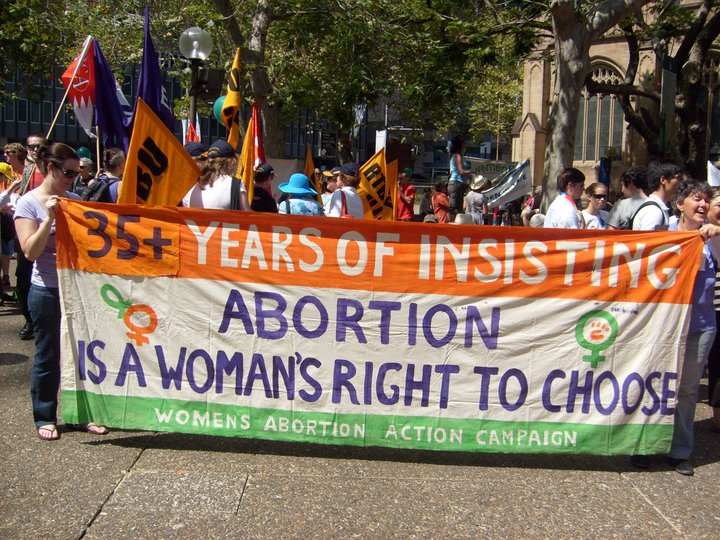
In the majority of the states and territories, abortion remains in the criminal code, the exceptions being Victoria, the ACT and Tasmania. The current political mood indicates that this situation probably won’t improve any time soon. It is more likely that the relative peace Australia has seen on abortion politics since the 1970s is over for now.
The landscape of reproductive politics seems to be changing in Australia, with anti-choice shots fired in NSW, Victoria, the Northern Territory, South Australia and Tasmania in recent months. Federally, Senator Madigan has threatened to hold the current government hostage over abortion.
In NSW the shift has happened suddenly, with the introduction of Zoe’s Law, the foetal personhood bill currently before the NSW parliament. Zoe’s Law aims to make it a crime to harm a foetus, specifically and beyond any harm to the mother. Abortion remains a crime in NSW.
Feminists, including myself, have opposed the bill because foetal personhood is anti-choice. It puts the (proposed) rights of the foetus into potential conflict with the rights of a mother. In the United States, this tactic has been used to side-swipe abortion rights. Both the Australian Medical Association (AMA) and the NSW Bar Association agree that it is a dangerous bill for both pregnant women and their doctors.
The Reverend Fred Nile, MLC, who typically has a number of anti-choice pieces of legislation before the parliament at any one time, originally sponsored the bill. However, it received more mainstream support, passing the lower house by 63 votes to 26. Premier Barry O’Farrell, generally regarded as a moderate on social issues, was one of those who voted for it.
Much of this debate is about whether a woman could potentially be criminally charged for harming her own foetus, or a doctor could be charged for performing an abortion. Medical and legal professionals have stated that the law is risky at best, and just as importantly, unnecessary legislation.
Since 2005, the definition of Grievous Bodily Harm has included “the destruction (other than in the course of a medical procedure) of the foetus of a pregnant woman, whether or not the woman suffers any other harm.” This is known as Byron’s Law.
In 2010 the law was subject to parliamentary review by Michael Campbell QC, and his report found that the current law “appropriately reflects the seriousness of the offence and, most importantly, differentiates between abortions and criminal acts by third parties resulting in fetal death.”
The members of parliament who passed the Zoe’s Law bill in the lower house appear to have been reassured by a late amendment from Liberal lower house member Mark Speakman of Cronulla. The Speakman amendment attempts to specifically exclude abortion from the bill by including wording to the effect that it could only apply to criminal acts.
Unfortunately, abortion is still covered in the Crimes Act, making the Speakman amendment a feel-good exercise at best.
Are these just the demented bleatings of a fringe-dwelling religious right? Yes and no. While Australia is overwhelmingly pro-choice, the attack in Victoria came from Liberal MP Bernie Finn. In the NT, the Attorney General has proposed laws that criminalise pregnant women who drink alcohol. In NSW, a female Liberal member is sponsoring Zoe’s Law in the upper house. ‘Zoe’ was the unborn daughter of NSW woman Brodie Donegan, who was struck by a drug-affected driver in 2009. When Zoe died in utero, the driver who caused her death was charged with injury to her mother.
In South Australia, the Labor government defeated an amendment similar to that proposed in NSW, known as the Brokenshire Bill, by only one vote. A group including Liberals, a Nick Xenophon group member, and Family First members voted for the bill.
But in NSW Labor were split – eight Labor members voted for Zoe’s Law, resulting in the expanded majority by which it was passed in the Legislative Chamber. The remaining 12 Labor members, including the Opposition Leader John Robertson, voted against the bill.
Federally, Prime Minister Abbott’s views on reproductive rights have been well documented. Perhaps less well known is Senator John Madigan, hailing from a party most in Australia thought was extinct, the right-wing Catholic Democratic Labor Party.
Madigan describes himself as “unashamedly pro-life” and in February last year he claimed that it was likely Australians were seeking gender-selective abortions because he had seen ”data that abortion on the basis of gender selection is happening overseas”. On this basis he introduced a failed bill to ban an unproven practice, mirroring a tactic used by successful anti-choice campaigners in the United States.
Post-July, when a grab bag of right-wing Senators holds the balance of power, these tactics could be successful, and pose a real problem, especially when combined with the current government.
Suffice to say that the consensus on women’s reproductive rights, if it ever existed, is under threat in Australia right now. It’s time to put on your armour and grab your weapon of choice.
We can’t rewind we’ve gone too far: on work and radio favourites
October 11, 2013 § 3 Comments

I was thinking about how one day, I’ll tell a story. It’ll be about how I worked this boring job when I was finishing my PhD dissertation. I’ll tell how the work was really dry, humbling, data-entry, grey-matter-spilling-out-my-ears boring, but that it was all ok in the long game, because I moved on to bigger things.
Then I thought, maybe that’s a story I should tell now, or at least start to tell. At the moment the most interesting thing I do at work is what I do to get through it and that’s what this post is about. Below is another favourites list of sorts, this time of radio shows.
I tell myself that most people end up doing some pretty shitty work for money at some point, and a lot, of course, don’t even have the option of doing boring work. So in lots of ways I’m lucky, I haven’t forgotten that. The reality is I could be tutoring at Uni, which isn’t boring, but for various reasons, that’s not my preferred way to earn money right now.
The work I’m doing is for an organisation I care about, and it’s necessary work that seems productive and important to me, so that’s something too. Even so, it often makes me want to smash my head into a computer, or do something crazy like get up and interpretive dance in the office (what would I dance? the spreadsheets? most boring dance ever), or better yet leave. Except, there’s the money thing.
What I’ve been doing to rescue myself is a) teaching myself to touch type, that sensible skill where you don’t look at the keyboard but type the words from your memory of the keys, b) listening to some language podcasts, and c) going through episode after episode of This American Life, and more recently Radiolab and Paper Radio (my new favourite).
This American Life is an hour long radio show exploring themes and social issues, mostly through personal narrative and interview. It has been running since 1995, so there’s a lot of material, and there are, correspondingly, a lot of favourite lists out there, as well as a few biting parodies. Nonetheless I thought that the two people who read this blog (kidding, there are three of you!) might like a list of my favourite social justice episodes. Also, I wanted to keep a list for myself somewhere, because I learned some things from these shows and it feels good to be able to quantify that, somehow.
These are the shows, in no particular order, that taught me something about race, gender, poverty, the prison system and/ or politics in the US of A:
The final act in this show is a story by Rennie, about high school girl Jenine. She’s trying to loose weight, stay away from her creepy step dad, catch ‘babes’ and keep her friends. Some parts of this were so painfully familiar that I cringed and had to pause the stream.. The depiction of an overwhelming, useless sense that her body is a big fleshy problem that she can’t fix is agonisingly spot on.
Secret Identity: The blond avenger
Act three is about an anonymous female avenger, who takes the lives of those she believes responsible for the deaths of young women in Juarez, Mexico’s infamously violent border city.
Harper High School, Part One and Part Two:
It’s hard to explain how moving this two part story is, without resorting to cliches. So much for first world problems; the problems the kids and teachers in this story face are blood and guts real. There’s gun violence and gang violence, and loss, and barriers to getting out, and the kind of desperate giving of some teachers who peel away layers of themselves trying to stem the consequences of all of it.
To break the list up with some humour, this episode features a gay sex columnist who decides to join the Republican Party, and the results are hilarious. I know Dan Savage can be a bit of a jerk, but I loved this episode, and it made me wonder why I hadn’t thought of this idea here in Oz.
In the last Act of this show, a teacher in a primary school institutes a rule: You can’t say “You can’t Play”. The way the kids deal with this rule, and the way they debate who is ‘sadder’, the kids that get socially rejected, or the kids who now have to play with their former friend rejects, is absolutely fascinating.
This episode is another painful one. The final Act is a story produced and told by Amity Bitzel about growing up with an abusive father. The hook is that he adopted a murderer into the family, for real, but the parts of the story that reached into my chest and caught hold of something there, are those where Amity talks about what it was like to live with the fear and unpredictability of abuse, and the interview with her dad where he justifies his actions.
Stories about the aftermath of Hurricane Katrina, and the racism that drove a lot of institutional decisions about how to deal with the survivors of the flood.
Money isn’t everything, but when you don’t have it or you’re about to lose it, you realise maybe rich people made up that saying. This is a story about a public school in a poor neighbourhood in Chicago. The school is about to lose the extra funding that’s been helping the teachers make up for some of the disadvantage their kids face, and Cathy, the best teacher in the school, is thinking of quitting.
Bonus: Paper Radio, The Cosmic Frequency
Paper Radio is a relatively new Australian and New Zealand podcast, both fiction and real life. I listened to one of their shows this week and it made me laugh and laugh. As the blurb says: “The Cosmic Frequency tells the story of Maggie Iaquinto, an American-born Australian who forged a unique relationship with the Russian cosmonauts aboard the space station Mir.” It’s all done via amateur radio. There’s a scene where the protagonist’s young son is woken up, in country town Victoria, by Russian astronauts calling for his mum, whom they call Rita (Russian for Maggie), through the radio in the kitchen.
Runners up: Dawn; Act V; The Giant Pool of Money; Cicero; I’m from the Private Sector and I’m here to Help; Habeas Schmabeas; The Convert; The View from Here; and Very Tough Love.
Do you have favourite podcasts? How do you keep going when big parts of your life are really not that interesting?
Photo by by Joe Haupt via Flickr.
(feminist) stuff I like
October 3, 2013 § Leave a comment
Recently I gave a workshop at an awesome conference out in Penrith called What’s Up West?

Here’s their logo, isn’t it sweet?
Part of the workshop was that I wrote a short list of feminist resources that I really love, roughly categorised into books, art, blogs and online mags, facebook pages, twitter handles and youtube vids.
Full disclosure: this is a list of stuff I like. It’s not an exhaustive list of feminist resources and it’s not meant to be. It’s things that have made me think, made my heart sing or skip a beat, and I wrote it with teen feminists in mind, but that doesn’t mean it’s all or ‘only’ for young adults.
Here it is:
Books
- bell hooks feminism is for everybody (link takes you to a free pdf of the book)
- Novels by Alice Walker or Margaret Atwood (especially The Handmaid’s Tale). I loved Alice Walker so much when I was about 20, and her novels taught me more about race and feminism than any non-fiction I was reading at the time.
- Poetry by Adrienne Rich or Dorothy Porter. My favourite Rich poem is called North American Time.
Art/ performers
Blogs/ online mags
- Rookie (esp anything by Jenny Zhang),
- Crunk Feminist Collective
- F Collective
- Black feminist ranter
- Poor Lass Zine
- Feministing
Facebook pages
Twitter folks
Thoughts from a man
Youtube
What feminist ‘stuff’ do you like? Add ’em in the comments!
“Women could do awesome shit”
July 27, 2013 § 1 Comment

Three photos of riot grrls in the 90s in NYC.
Last night I had a wonderful opportunity to speak at one of Colectivo Mujer’s Through Our Eyes film screenings. They showed ‘Grrrl Love and the Revolution’, a film by Abby Moser about riot grrrl culture in New York in the 90s. Here is the trailer:
Here’s a rough version of what I had to say about the film and about how riot grrrl relates to my experience of ‘do it yourself’ (DIY) feminism:
First I want to acknowledge that I’m sitting on Aboriginal land, pay my respects to the elders, and extend that respect to any Aboriginal people here tonight.
Thanks to Rosarela and Colectivo Mujer for inviting me, it’s good to be amongst feminists and friends.
I’m going to talk about the film a little bit and relate it to some of my experiences in Sydney and some things I’m often thinking about: feminism and creativity.
Would any one here ID as an artist/ creative of some sort? Me too.
In many ways the culture represented in the film is unfamiliar to me. I’m not a punk rocker and some of you who know me might find the idea of me as a riot grrrl fairly ironic (I’m pretty mild-mannered). So let’s establish some familiar territory:
Many of us are feminists because of sexism in our communities, at work, because of sexual assault (often at home), narrow gender roles, slut shaming – these things might make us feminists, and these things made riot grrrls feminists.
Some more familiar territory is that these women thought – and felt – that they could change things.
Has anyone here ever been part of a feminist movement where you felt you could change some stuff? I have too.
I come from a tradition of organising, mostly student and trade union organising, that really focuses on capital C change – legislation, government – in my state, country, occasionally someone else’s country, then there’s political parties, school or church or organisation’s policy etc. And there’s definitely value in that and I want that activism to keep happening – at the moment for example I’m working on a campaign about cuts to the single parent pension. But I’ve also certainly felt over the years that this was sometimes a really OVERWHELMING task, and if there wasn’t an obvious target, then this sort of activism would stall.
On the street, for folks who care but aren’t necessarily activists, I reckon people often also feel like its really hard to make change.
Last year when I was feeling a bit overwhelmed with capital C change, I was lucky enough to go overseas for a while. I was in Spain and Germany to be precise, and I saw all this street art culture everywhere. This really made me want to do activism through street art, even though I felt I lacked the skills. So when I got home, my feminist buddy Corina and I started a practice of feminist street art, and the thing was that we had inspiration to draw on because feminists had done this riot grrl DIY stuff before us.
Our art was definitely part of campaigning – some of it was about Bankstown being targeted in changes to Centrelink, for example – but some of it was also about making beautiful things that made us feel good and feel like feminist bad asses and so on. Hopefully it also made other people feel good when they saw it. In some ways this is the super accessible feminism of my dreams.
Like the girl in the film said, riot grrrl is about doing stuff, direct action, and that was what I wanted for my feminism at that time.
A question I’ve seen asked a bit is whether riot grrrl tactics, zines and so on, are defunct due to the internet. After all a lot of their ideas, such as actual snail-mailing lists, came about without the Internet. DIY is not taken out of action by social media, though. Zines are still happening, and music, and art. But the internet changes it, and changes the distribution patterns. It’s a lot of work, too. Not only do I have to make my art but I also feel obliged to document it online, to put it on my blog, etc etc. What this says to me is that we need more people than ever involved and doing stuff, sharing the work and the action.
On the flip side, DIY can make production easy again too. I can’t make a glossy graphic poster for example, at least not yet. I can make a pretty great poster with scissors and glue though, and I can draw, so there’s always a way if I am willing to consider these options when I am organising.
As one Colombian riot grrrl said, “I learned that we have the strength needed to make our dreams come true.” I would add, and the resources.
I think this is for me the insight and power of Riot Grrl – the sense that change and possibility can happen right here, right now. I think that what riot grrl does is present a whole bunch of possible new realities. You could learn guitar and start a punk band, you could write your own mag, you could take this fat texta in my bag and write about how awesome you and your best feminist friends are on that wall over near Erko train station, you could make art and hang it on the canvas that is the street.
I guess the question of what sort of change music and art and zines can make is a big one that I think we should ‘post it’ for discussion later tonight.
Which kind of brings me to what I see as some of the values of riot grrl, because there is political analysis there, even if it’s pretty disparate – there’s commentary on class and access to education in terms of sharing what we know, for example.
I guess what I see as the other main ethic of riot grrl is that it saw/ sees women as artists with total, full potential as human beings. Women could do awesome shit and lead crazy amazing lives and make art and music. These were and are people who deeply value self-expression/ creation. Riot grrls are saying that they/ you/ we can be artists and conversely that their/ your/ our self-expression is valid. My question here is who is and isn’t represented in this “they/ you/ we”? What special codes & language do you have to know to be read as a person of value in riot grrl culture? In a culture so informally organised, where doing stuff really depends on friendship, who is in or out? [Mimi Thi Nyugen has an awesome article on riot grrrl and race that I’ll embed here – it’s academic but worth wading through. Link is to PDF]
I want to finish up with two examples of DIY culture that aren’t necessarily riot grrrl but are part of the DIY feminism tradition. They’ve both inspired me recently:
Femme Shark Manifesto (last night I mistakenly said Leah Lakshmi Piepzna-Samarsinha was of Latina heritage, whereas she is actually of Sri-Lankan & Ukranian & Irish background, apologies! Again link is to PDF).
With thanks to Rosarela, Corina and Rosa, whose thoughts and deeds inspire and sustain me.
 The Filing Cabinet